Chinese Startup Debuts Super-Bendy Robotic Arm for Orbital Repairs
Reading time 2 minutes
A limber robot perched atop a satellite carried out a series of refueling tests in space for the first time, bringing China a step closer to in-orbit servicing capabilities that could extend the lifespan of spacecraft.
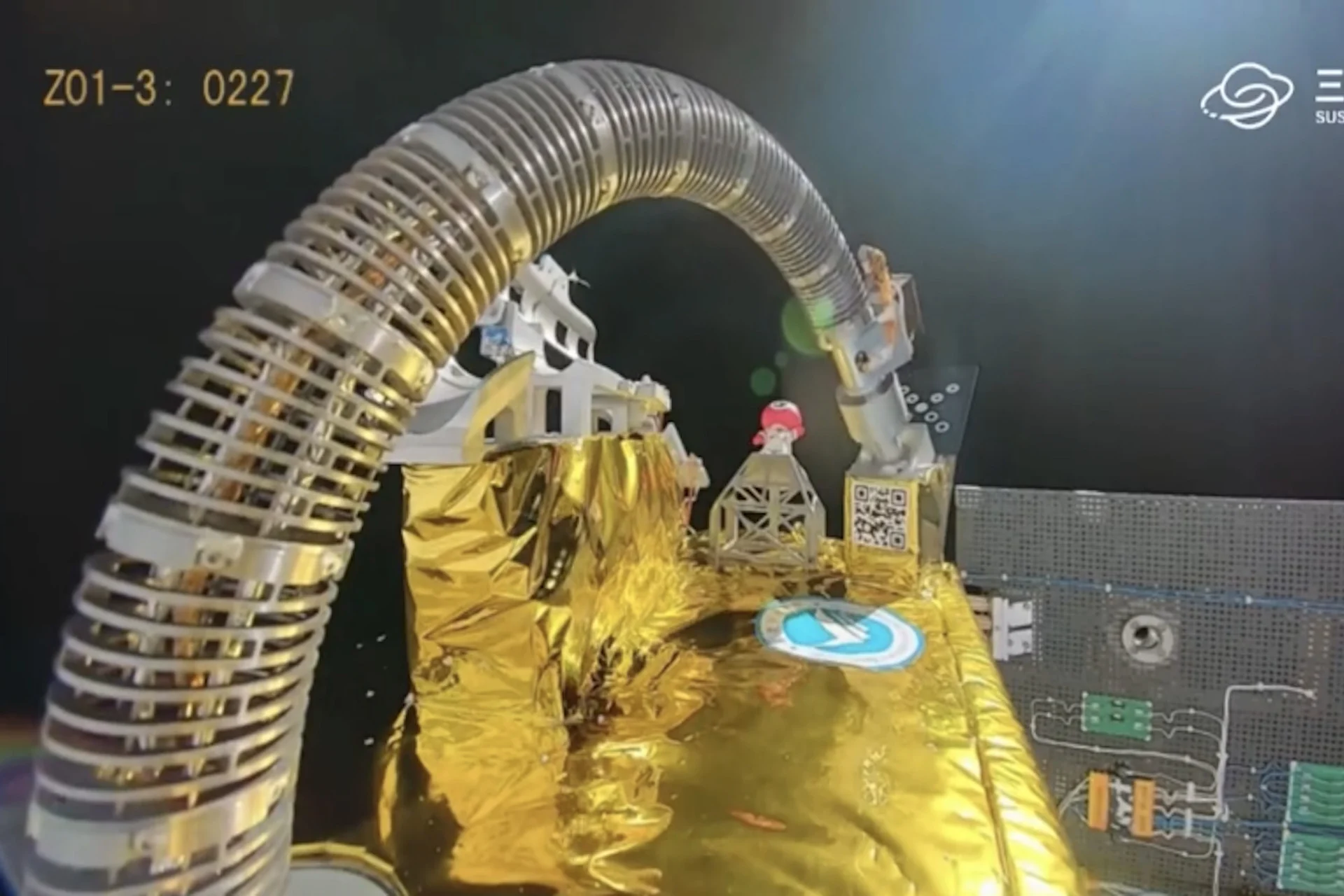
Chinese startup Sustain Space tested its flexible robotic arm through simulated orbital tasks, successfully verifying four modes of operation during the technology demonstration, according to a company statement. The relatively bendy robot is made of a series of spring-like tubes, allowing it to twist or curl in different ways to refuel and repair spacecraft, as well as move space debris out of the way.
Need an arm?
Sustain Space’s Xiyuan-0 satellite launched on March 16 on board a Kuaizhou-11 rocket from the Jiuquan Satellite Launch Center in China. The satellite is equipped with a flexible robotic arm designed to carry out complex in-orbit operations.
During its time in space, engineers put the robotic arm through the wringer. The flexible robot performed a series of simulated tasks, including ground-controlled, autonomous, and vision-guided refueling simulations, as well as force-compliant manipulation and precision control.
“The satellite has successfully completed all on-orbit operations of its flexible robotic arm, marking a solid step forward for China’s commercial aerospace industry in the field of on-orbit space services,” Sustain Space wrote in a translated statement.
The robot is designed with a hollow arm composed of a series of spring-like tubes that connect to each other, along with motors that allow it to pull on cables.
Robotic services
The space industry features a few robotic limbs that perform vital tasks in orbit, such as assembling spacecraft, assisting astronauts, and maintaining satellites.
The 57-foot-long (17-meter) Canadarm2 is attached to the International Space Station (ISS) and helps move supplies, dock spacecraft, and support work being done during spacewalks. The European Robotic Arm (ERA) is the first robot able to “walk” around the Russian segment of the ISS, designed with an elbow, shoulders, and even wrists. Japan’s Experiment Module Remote Manipulator System, also known as Kibo, assists in experiments conducted on the ISS.
China’s flexible robotic arm is the first of its kind, mainly designed for the purpose of supporting the sustainability of the space industry through in-orbit operations. Other space startups are looking to develop the same type of in-orbit servicing, albeit using different technologies. The bendy robot’s recent demonstration highlights the Chinese space industry’s advancement toward maintaining orbiting spacecraft.
Explore more on these topics
Sign up for our newsletters
Subscribe and interact with our community, get up to date with our customised Newsletters and much more.
Related Articles



Source link