HCLTech sees $20 billion India enterprise AI opportunity with Sarvam partnership
HCLTech's investment in Sarvam AI marks a push into sovereign AI, with both companies planning to develop custom AI models, expand AI infrastructure, and target enterprise and government clients. HCLTech estimates India's enterprise AI market at $20 billion, while Sarvam plans to use fresh capital to build next-generation models and expand globally through AI services tailored to customer data and workflows.

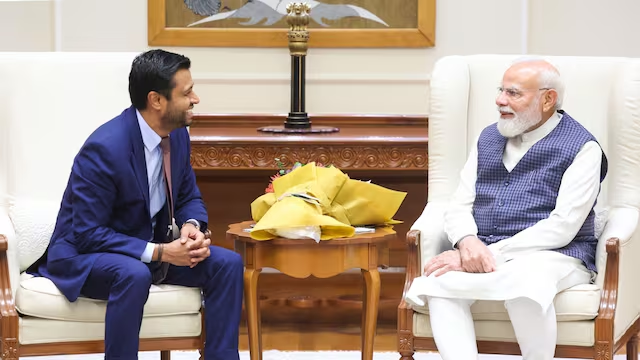
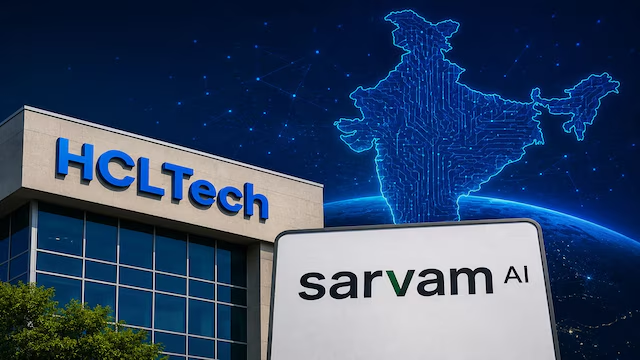
HCLTech 's decision to acquire a 10.5% stake in Sarvam AI is more than just a strategic investment. The company sees it as an entry into what Chief Executive Officer and Managing Director C Vijayakumar described as the "sixth big opportunity" for HCLTech, as it expands its presence in the rapidly evolving sovereign artificial intelligence (AI) market.
Vijayakumar estimates India's enterprise AI market alone is worth at least $20 billion. "Everybody wants to have control over how they are deploying the technology because these are all very large, strategically important institutions. So, the enterprise market in India is a big opportunity, and we are playing the enterprise market purely with AI-led services," he said.
The partnership also positions both companies to pursue international opportunities as enterprises increasingly adopt hybrid AI architectures that combine private models with frontier AI systems.
Sarvam AI plans to use the fresh capital to develop new AI models and expand its compute infrastructure while leveraging HCLTech's enterprise network to scale its offerings.
This is an edited transcript of the interview.Q: It was two years ago at the National Family Leadership Forum where you and I spoke, and you had very categorically stated that India needs its own foundational models. India needs its own LLMs because that will be imperative from a national priority point of view. It's taken a while for you to make this bet, and that's the feedback coming in as well that why have you waited as long as you have? And what finally tipped things in favour of Sarvam?C Vijayakumar: I'm glad you recalled that old conversation, which was in January 2025. At that time, I did not know about Sarvam, and probably Sarvam was also in its early days. We met during the India AI Summit in February, around the same time we were talking to you as well.
Of course, we found Pratyush, Vivek, and the team incredibly exciting, along with the platform that they've built. The adoption and the quality - all of that was just very exciting. Then we started the conversation, and we got this done very quickly. We are absolutely thrilled that it will open up a completely new chapter of opportunities for us as a company, and we will help Sarvam scale up as well.
Q: A $300 million fundraise, with $150 million coming in from HCLTech. What are you going to be deploying all of this capital for? Take me through what the runway now looks like.Pratyush Kumar: You and I have been chatting about this a few times now. The thesis of sovereign AI, which is what we've started with, is becoming increasingly real. The atmosphere is clear that the most important component of technology cannot be rented; you have to have control over it. That's what the company was founded on.
To your point about what we're going to do with all this money, AI is something that takes capital to build and scale. Whether it's training the next class of models, this is, in some sense, day zero of being globally competitive. With CVK coming in and other investors coming in, this is the time when we start playing internationally.
For us, therefore, the capital will be deployed to build the next generation of models and also scale up our compute footprint in India to serve enterprises, startups, and the government. These are the two broad areas that we'll be investing in - excited that we are on to this next orbit of Sarvam.
Q: Let's now talk about the next chapter, in your words, and the opportunities that this deal - picking up a 10.5% stake in Sarvam -opens up for a company like HCLTech.C Vijayakumar: We've been continuously looking at new opportunities and creating completely new businesses. As you would have heard me talking about, we have AI Factory, Physical AI, and differentiated IP. There are five different propositions on which we are leading, including building custom chips for inference and things like that.
So, this opens up the sixth big opportunity for us, which is sovereign AI. In my view, there are four different opportunities in sovereign AI. First and foremost is the Indian sovereign AI opportunity, which includes Indian enterprises in banking, insurance, government, tech, and other commercial sectors.
All of them are looking to adopt AI in a significant way, and everybody wants to have control over how they are deploying the technology because these are all very large, strategically important institutions. So, the enterprise market in India is a big opportunity, and we are playing the enterprise market purely with AI-led services.
The second opportunity is the Indian government. Across citizen services, there is tremendous opportunity for reimagination, which Pratyush and the Sarvam team have already started working on.
In addition to that, the global market is even more exciting, and the total addressable market (TAM) is very large. The way enterprise AI architecture is evolving - of course, it is evolving very fast—the most optimal solution would be some kind of hybrid model.
You don't need frontier-model capabilities for doing a lot of basic, high-intensity, high-volume tasks within enterprises. So, it will be a private SLM that is client-specific or industry-specific. Clients would deploy these models, build agentic tech and other capabilities around them, and run a lot of their day-to-day operating model, while leveraging frontier models for tasks they are truly suited for.
The hybrid model gives you data security, very good price performance, and, in many countries, multilingual capabilities. These three factors make it a very powerful solution that we can take to global enterprises.
The fourth opportunity is taking sovereign AI to many other countries, which the Sarvam team is already working on. We have a strong presence across the globe and would be able to take this offering to those countries as well.
Q: If you can just quantify the addressable market that you speak of, both the enterprise market in India that you intend to target as well as the international markets that you intend to go after. You're absolutely right—we are now in a phase where token-maxing is no longer the trend. Efficiency and optimisation are what everybody is looking at. But there are other players who are already doing small language models. SLMs are not new to the market. So, what will be the differentiator for Sarvam and HCLTech as you try to address this market? And if you can quantify for me the total TAM - India enterprise plus global - that you're looking at.C Vijayakumar: India enterprise AI market is at least $20 billion in size, but the global market will be at least 100 times that. That's what I would say.
It's really big because every enterprise is spending on AI now. They need a solution that is very optimal from a price-performance perspective. People are struggling with, as you said, token-maxing and many other challenges.
So, the global market opens up a very large TAM. I don't want to quantify it further, but it's very significant. Maybe Pratyush can add more on the global market.
Q: Do add to that, Pratyush, and also explain to us how ready you are to address this enterprise market. You've already got large incumbents there. You've, of course, got Anthropic and OpenAI also addressing both the Indian and global enterprise markets. What will be the key differentiator as far as you are concerned, and how ready are you to address this?Pratyush Kumar: That's a very good question, and it's good to give your viewers some clarity on that. What we have achieved at Sarvam is the ability to train from scratch a large language model (LLM) with more than 100 billion parameters. We had no dependency on external data, engineering, R&D, or infrastructure, and we were able to do that end-to-end.
The reason we put ourselves through the challenge of doing that end-to-end is exactly for this moment. We can now tell enterprises, through the deep partnerships that HCLTech has, that we can take your context- your data, your tools, and the enterprise machinery you have created - and fine-tune models to perform exceptionally well on the workflows and tasks you care about.
In fact, Satya Nadella wrote an interesting article about how a frontier ecosystem is required for equilibrium. This is the same story. You can't have two or three companies in the world providing the most important component in a post-AI world.
Every company will have to say: here is my data, here are my workflows, and here are the things I care about. How do I build a custom model for this?
And this requires R&D. Just like India succeeded in IT services, the opportunity starting today is: how do we win in AI services? It will be R&D-led; it will have a very different product surface, but it will also require the deep consultative and trust-based relationships needed to succeed.
I think that's a massive opportunity. CVK mentioned the numbers, but I would say it's worth multiple trillions of dollars. It's an entirely new platform and paradigm.
The advantage of getting in early and compounding is very high because once you are doing this for a few enterprises, you can scale much faster. What happened at the frontier level - aggregating the world's intelligence in one place - is now going to be replicated across organisations with their own trusted setups. That is what we are working toward.
Q: Let's talk a little bit about the timing as well. I know you have nothing to do with it, but the fact of the matter is that we are on the cusp of a very significant development. As you pointed out, renting intelligence now has a question mark attached to it because of developments in the US under the Trump administration. How much of that is likely to provide a tailwind, so to speak, for companies like yours?Pratyush Kumar: Look, these are structural things. Of course, the events are interesting, and this particular one has many different implications. I wrote about it on Twitter.
But these are structural aspects. If you go back a couple of decades, people started using databases. The first databases were esoteric and hard for people to figure out. Over time, things got democratised, but then specialised again, then democratised again, and so on.
AI may look like a winner-take-all market, but I don't think it is. We've always believed that. The tools for building AI, consuming AI, and adapting AI will become democratised, but with a product surface that is very research-led.
That is where the opportunity lies. There has to be passion within countries like India to build this capability. India is going to be a big market, and per-capita AI consumption is still very low. We'll expand that and also take these capabilities to companies globally.
Q: I want to understand from you, because you've heard this question being asked several times in the past as well. Indian IT has been slow to the AI party. You haven't made the R&D investments that were needed. Indian IT companies have focused much more on buybacks and dividends. Is this an existential moment? And is your response to that existential moment this bet on Sarvam?C Vijayakumar: I've answered this many times. The existential threat to Indian IT has been written about many times. We've collectively reinvented ourselves, and we continue to be a major force to reckon with for global enterprises.
Of course, we could have invested more in R&D. We could have built models like this had we put enough energy and intensity into it. But it's never too late.
This is a great way to partner, and it's also not easy to innovate at this scale within a large company. Partnerships with Sarvam and other startups can amplify what we do.
We are finding the right way to continue remaining highly relevant. We are super-confident about our AI-led services such as AI Factory, Physical AI, and many other initiatives. This partnership adds a very powerful dimension to what we intend to do.
Q: Does it change the trajectory as far as your AI revenues are concerned? You've been among the first in the industry to call out standalone AI revenue. Does this change the trajectory on that front?C Vijayakumar: Yes, this adds one more growth lever. It's not just AI revenue; we call it advanced AI revenue because everybody is classifying AI used for delivering services as AI revenue, but that's really par for the course.
We are calling out advanced AI revenue for some specific offerings, and this provides one more strong growth vector to the overall strategy that we have.
For the full interview, watch the accompanying video Catch all the latest updates from the stock market here
Vijayakumar estimates India's enterprise AI market alone is worth at least $20 billion. "Everybody wants to have control over how they are deploying the technology because these are all very large, strategically important institutions. So, the enterprise market in India is a big opportunity, and we are playing the enterprise market purely with AI-led services," he said.
Sarvam AI Co-founder Pratyush Kumar said the company's founding belief that critical AI capabilities cannot simply be rented is now gaining wider acceptance. "The thesis of sovereign AI, which is what we've started with, is becoming increasingly real," he said.
The partnership also positions both companies to pursue international opportunities as enterprises increasingly adopt hybrid AI architectures that combine private models with frontier AI systems.
Sarvam AI plans to use the fresh capital to develop new AI models and expand its compute infrastructure while leveraging HCLTech's enterprise network to scale its offerings.
This is an edited transcript of the interview.Q: It was two years ago at the National Family Leadership Forum where you and I spoke, and you had very categorically stated that India needs its own foundational models. India needs its own LLMs because that will be imperative from a national priority point of view. It's taken a while for you to make this bet, and that's the feedback coming in as well that why have you waited as long as you have? And what finally tipped things in favour of Sarvam?C Vijayakumar: I'm glad you recalled that old conversation, which was in January 2025. At that time, I did not know about Sarvam, and probably Sarvam was also in its early days. We met during the India AI Summit in February, around the same time we were talking to you as well.
Of course, we found Pratyush, Vivek, and the team incredibly exciting, along with the platform that they've built. The adoption and the quality - all of that was just very exciting. Then we started the conversation, and we got this done very quickly. We are absolutely thrilled that it will open up a completely new chapter of opportunities for us as a company, and we will help Sarvam scale up as well.
Q: A $300 million fundraise, with $150 million coming in from HCLTech. What are you going to be deploying all of this capital for? Take me through what the runway now looks like.Pratyush Kumar: You and I have been chatting about this a few times now. The thesis of sovereign AI, which is what we've started with, is becoming increasingly real. The atmosphere is clear that the most important component of technology cannot be rented; you have to have control over it. That's what the company was founded on.
To your point about what we're going to do with all this money, AI is something that takes capital to build and scale. Whether it's training the next class of models, this is, in some sense, day zero of being globally competitive. With CVK coming in and other investors coming in, this is the time when we start playing internationally.
For us, therefore, the capital will be deployed to build the next generation of models and also scale up our compute footprint in India to serve enterprises, startups, and the government. These are the two broad areas that we'll be investing in - excited that we are on to this next orbit of Sarvam.
Q: Let's now talk about the next chapter, in your words, and the opportunities that this deal - picking up a 10.5% stake in Sarvam -opens up for a company like HCLTech.C Vijayakumar: We've been continuously looking at new opportunities and creating completely new businesses. As you would have heard me talking about, we have AI Factory, Physical AI, and differentiated IP. There are five different propositions on which we are leading, including building custom chips for inference and things like that.
So, this opens up the sixth big opportunity for us, which is sovereign AI. In my view, there are four different opportunities in sovereign AI. First and foremost is the Indian sovereign AI opportunity, which includes Indian enterprises in banking, insurance, government, tech, and other commercial sectors.
All of them are looking to adopt AI in a significant way, and everybody wants to have control over how they are deploying the technology because these are all very large, strategically important institutions. So, the enterprise market in India is a big opportunity, and we are playing the enterprise market purely with AI-led services.
The second opportunity is the Indian government. Across citizen services, there is tremendous opportunity for reimagination, which Pratyush and the Sarvam team have already started working on.
In addition to that, the global market is even more exciting, and the total addressable market (TAM) is very large. The way enterprise AI architecture is evolving - of course, it is evolving very fast—the most optimal solution would be some kind of hybrid model.
You don't need frontier-model capabilities for doing a lot of basic, high-intensity, high-volume tasks within enterprises. So, it will be a private SLM that is client-specific or industry-specific. Clients would deploy these models, build agentic tech and other capabilities around them, and run a lot of their day-to-day operating model, while leveraging frontier models for tasks they are truly suited for.
The hybrid model gives you data security, very good price performance, and, in many countries, multilingual capabilities. These three factors make it a very powerful solution that we can take to global enterprises.
The fourth opportunity is taking sovereign AI to many other countries, which the Sarvam team is already working on. We have a strong presence across the globe and would be able to take this offering to those countries as well.
Q: If you can just quantify the addressable market that you speak of, both the enterprise market in India that you intend to target as well as the international markets that you intend to go after. You're absolutely right—we are now in a phase where token-maxing is no longer the trend. Efficiency and optimisation are what everybody is looking at. But there are other players who are already doing small language models. SLMs are not new to the market. So, what will be the differentiator for Sarvam and HCLTech as you try to address this market? And if you can quantify for me the total TAM - India enterprise plus global - that you're looking at.C Vijayakumar: India enterprise AI market is at least $20 billion in size, but the global market will be at least 100 times that. That's what I would say.
It's really big because every enterprise is spending on AI now. They need a solution that is very optimal from a price-performance perspective. People are struggling with, as you said, token-maxing and many other challenges.
So, the global market opens up a very large TAM. I don't want to quantify it further, but it's very significant. Maybe Pratyush can add more on the global market.
Q: Do add to that, Pratyush, and also explain to us how ready you are to address this enterprise market. You've already got large incumbents there. You've, of course, got Anthropic and OpenAI also addressing both the Indian and global enterprise markets. What will be the key differentiator as far as you are concerned, and how ready are you to address this?Pratyush Kumar: That's a very good question, and it's good to give your viewers some clarity on that. What we have achieved at Sarvam is the ability to train from scratch a large language model (LLM) with more than 100 billion parameters. We had no dependency on external data, engineering, R&D, or infrastructure, and we were able to do that end-to-end.
The reason we put ourselves through the challenge of doing that end-to-end is exactly for this moment. We can now tell enterprises, through the deep partnerships that HCLTech has, that we can take your context- your data, your tools, and the enterprise machinery you have created - and fine-tune models to perform exceptionally well on the workflows and tasks you care about.
In fact, Satya Nadella wrote an interesting article about how a frontier ecosystem is required for equilibrium. This is the same story. You can't have two or three companies in the world providing the most important component in a post-AI world.
Every company will have to say: here is my data, here are my workflows, and here are the things I care about. How do I build a custom model for this?
And this requires R&D. Just like India succeeded in IT services, the opportunity starting today is: how do we win in AI services? It will be R&D-led; it will have a very different product surface, but it will also require the deep consultative and trust-based relationships needed to succeed.
I think that's a massive opportunity. CVK mentioned the numbers, but I would say it's worth multiple trillions of dollars. It's an entirely new platform and paradigm.
The advantage of getting in early and compounding is very high because once you are doing this for a few enterprises, you can scale much faster. What happened at the frontier level - aggregating the world's intelligence in one place - is now going to be replicated across organisations with their own trusted setups. That is what we are working toward.
Q: Let's talk a little bit about the timing as well. I know you have nothing to do with it, but the fact of the matter is that we are on the cusp of a very significant development. As you pointed out, renting intelligence now has a question mark attached to it because of developments in the US under the Trump administration. How much of that is likely to provide a tailwind, so to speak, for companies like yours?Pratyush Kumar: Look, these are structural things. Of course, the events are interesting, and this particular one has many different implications. I wrote about it on Twitter.
But these are structural aspects. If you go back a couple of decades, people started using databases. The first databases were esoteric and hard for people to figure out. Over time, things got democratised, but then specialised again, then democratised again, and so on.
AI may look like a winner-take-all market, but I don't think it is. We've always believed that. The tools for building AI, consuming AI, and adapting AI will become democratised, but with a product surface that is very research-led.
That is where the opportunity lies. There has to be passion within countries like India to build this capability. India is going to be a big market, and per-capita AI consumption is still very low. We'll expand that and also take these capabilities to companies globally.
Q: I want to understand from you, because you've heard this question being asked several times in the past as well. Indian IT has been slow to the AI party. You haven't made the R&D investments that were needed. Indian IT companies have focused much more on buybacks and dividends. Is this an existential moment? And is your response to that existential moment this bet on Sarvam?C Vijayakumar: I've answered this many times. The existential threat to Indian IT has been written about many times. We've collectively reinvented ourselves, and we continue to be a major force to reckon with for global enterprises.
Of course, we could have invested more in R&D. We could have built models like this had we put enough energy and intensity into it. But it's never too late.
This is a great way to partner, and it's also not easy to innovate at this scale within a large company. Partnerships with Sarvam and other startups can amplify what we do.
We are finding the right way to continue remaining highly relevant. We are super-confident about our AI-led services such as AI Factory, Physical AI, and many other initiatives. This partnership adds a very powerful dimension to what we intend to do.
Q: Does it change the trajectory as far as your AI revenues are concerned? You've been among the first in the industry to call out standalone AI revenue. Does this change the trajectory on that front?C Vijayakumar: Yes, this adds one more growth lever. It's not just AI revenue; we call it advanced AI revenue because everybody is classifying AI used for delivering services as AI revenue, but that's really par for the course.
We are calling out advanced AI revenue for some specific offerings, and this provides one more strong growth vector to the overall strategy that we have.
For the full interview, watch the accompanying video
First Published: Jun 16, 2026 10:55 AM IST
Source link