
Mint Explainer | Can connected cars help India cut road fatalities?


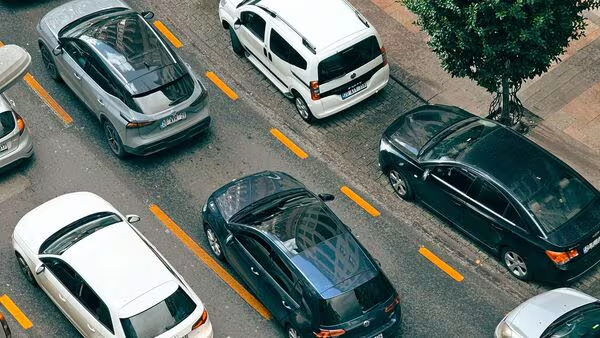
India has opened up airwaves to allow cars to communicate directly with each other. This technology can help vehicles share safety warnings in real time, such as alerts about sudden braking, accidents or other dangers on the road. But how much difference can it make on India's roads and how can it reduce accidents? Mint explains
Why is vehicle connectivity technology important for India?
The technology that facilitates direct communication between vehicles is critical for India, which faces a severe road safety crisis. According to official figures, India recorded 487,705 accidents and 177,177 fatalities from road accidents in 2024.
Auto industry and tech companies point out that since a vast majority of these accidents are caused by human error, such vehicle connectivity technologies can provide proactive, pre-crash interventions to mitigate these issues. Think tanks like the Broadband India Forum (BIF), which also represents big tech companies, emphasize that reducing accidents through such technology-enabled prevention mechanisms can generate substantial economic as well as societal benefits. It estimates the financial burden of road accidents at 3.14% of the nation’s gross domestic product (GDP).
How does the technology work?
Vehicle-to-vehicle (V2V) technology enables cars to wirelessly exchange real-time data, such as position, speed, and braking patterns, over a direct communication network. To ensure these signals can be transmitted reliably and without interference, vehicles need access to dedicated spectrum, or airwaves, set aside for such communications.
Now, the in-car communication devices, known as on-board units (OBUs), can be installed licence-free in vehicles and the automakers and technology providers can start with pilot projects. According to industry executives, once rolled out, the new technology can help vehicles detect hazards beyond their line of sight, unlike radar and cameras that can be affected by obstacles or poor weather. The technology also complements existing advanced driver assistance systems (ADAS) by warning drivers about dangers that may be hidden from a vehicle's onboard sensors.
What is still missing for a full tech rollout in India?
While the recent spectrum decision clears the way for vehicle-to-vehicle (V2V) communication, it is only one component of the broader vehicle-to-everything (V2X) technology ecosystem.
V2X also includes vehicle-to-infrastructure (V2I) communication, which enables vehicles to interact with traffic signals, toll plazas, road signs and other roadside infrastructure known as roadside units (RSUs). However, the regulatory framework for V2I remains under discussion. A regulatory framework is required to determine exactly who is authorized to build, operate, and manage this infrastructure.
The telecom regulator will also have to decide whether V2I should be treated as a commercial telecom service managed by telecom operators through auctioned spectrum, or as a public safety tool managed by road authorities under a "light-touch" shared model.
Has the technology improved road safety elsewhere?
While specific historical fatality-reduction percentages from other countries are limited because global implementation is still largely in the pilot or early mass-deployment stages, international trials have shown promising results.
For example, in November 2016, the National Highway Traffic Safety Administration (NHTSA) in the U.S. did a cost benefit analysis which estimated that the implementation of such systems can lead to at least a 13-18% reduction in traffic accidents. The same would mean avoiding 439,000-615,000 crashes in the U.S. alone.
Field tests conducted by Japan’s Fire and Disaster Management Agency in Nagoya and Toyota cities found that ambulances equipped with ITS (intelligent transport system)-connect technology recorded an average 7.7% reduction in emergency driving time across 16 traffic-signal junctions on a major route.
India is a signatory to the Stockholm declaration of February 2020 and is formally committed to reducing road fatalities and injuries by 50% by 2030. The ministry of road transport and highways (MoRTH) views the mass adoption of V2X as one of the key technological measures required to achieve this specific reduction target.
What are the main challenges in making this work on Indian roads?
Implementing V2X technology on Indian roads presents unique challenges, primarily due to the country's heterogeneous traffic, unpredictable vehicle behavior, and poor lane discipline.
The Automotive Research Association of India (ARAI) earlier this month told the telecom regulator that India cannot simply transplant Western frameworks designed for enclosed vehicles and orderly lane driving. India has a massive fleet of 210 million registered two-wheelers that are structurally invisible to global V2X architectures, requiring custom development and fatality-weighted deployment methodologies.
Ensuring multi-vendor interoperability across different vehicle brands and infrastructure providers without fragmenting the ecosystem is also a critical challenge stated by both telecom and automotive stakeholders.
Additionally, infrastructure readiness is a major hurdle. Deploying RSUs requires a reliable power supply and integration with existing traffic management systems, which are often inadequate outside major urban centres.
About the Author
Jatin is based in New Delhi and writes on telecom and technology with a keen interest in policy and regulation. With over five years of reporting experience across Informist Media, Financial Express and now Mint, he has extensively covered the telecom, information technology, electronics and semiconductor sectors.<br><br>A commerce graduate, Jatin's work focuses on tracking industry developments, regulatory changes and policy decisions that shape India’s evolving digital ecosystem. Over the years, he has reported on key trends and shifts across these sectors, bringing clarity to complex policy and business issues.<br><br>Known for his strong news sense, Jatin focuses on breaking stories and delivering in-depth reporting that offers readers an understanding of complex topics, policy decisions and corporate developments. His work often examines the intersection of policy and business, highlighting how regulatory decisions impact industry strategy, pricing, and consumer outcomes.<br><br>He brings a strong domain understanding for Mint and his work is widely picked up by other media firms. With a focus on accuracy and depth, he aims to break down developments into clear, accessible insights for readers, while continuing to track emerging trends shaping the future of India’s telecom and technology sectors.
Catch all the Technology News and Updates on Live Mint. Download The Mint News App to get Daily Market Updates & Live Business News.
MoreSource link