BenchmarksLIVE
BenchmarksLIVE


Business NewsTechAI Our capital-raise is large for India but quite small in global context: Sarvam’s Vivek Raghavan
Our capital-raise is large for India but quite small in global context: Sarvam’s Vivek Raghavan


Synopsis
In an interview with ET, Sarvam cofounder Vivek Raghavan said the company would use the capital to build compute infrastructure, train and finetune models, scale inferencing, and build software layers for enterprise and government customers.

Listen to this article in summarized format
India’s homegrown artificial intelligence (AI) startup Sarvam has raised $234 million in an ongoing funding round led by HCLTech, valuing the company at $1.5 billion.
The round, expected to close at $300 million, also saw participation from Bessemer Venture Partners and existing investors Khosla Ventures and Peak XV Partners. HCLTech is investing $150 million in the round, marking the first major strategic bet by an Indian IT services company on the foundation model ecosystem, at a time when the debate on the need for sovereign AI is growing louder in India.
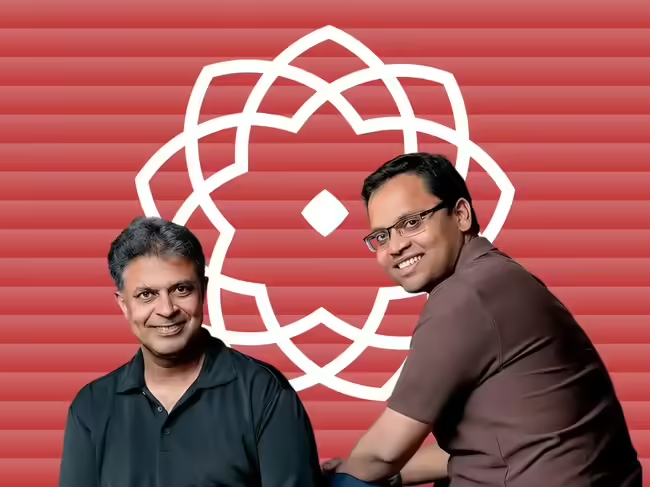
In an interview with ET, Sarvam cofounder Vivek Raghavan said the company would use the capital to build compute infrastructure, train and finetune models, scale inferencing, and build software layers for enterprise and government customers. He said Sarvam’s conversational AI platform handles over 2 million calls a day, while the company saw more than 300 million application programming interface (API) calls last month
Also read | Anthropic ban: Sarvam AI's Pratyush Kumar warns against reliance on foreign models
Bessemer partner Pankaj Mitra said Sarvam will be among the “biggest bets” in India’s technology ecosystem over the next decade.
Edited excerpts:
What was the thought process behind bringing in HCLTech as a strategic investor?
Vivek Raghavan: We are in an era of sovereign AI. We’ve seen what happened with Fable 5 and Mythos… when you’re running a sovereign AI company, it’s important to get investment that is Indian. That’s why we’ve collaborated with HCLTech for this funding.
HCLTech has taken a stake, but Sarvam will continue to operate as an independent company. There is no question about that.
Is there also a go-to-market angle to this partnership?
Raghavan: There will definitely be opportunities where we can go to market together, both in India and outside. Those synergies are things we will work out over time. But having said that, we will use every possible channel to proliferate our technology.
We saw access to advanced models like Fable and Mythos being restricted. Does Sarvam's focus still remain on low-cost models or will we need to build comparable capabilities?
Raghavan: The capital we have raised is very large in the Indian context, but it is still quite small compared with the global context. We will have to continue being capital efficient in how we do things. At the same time, we also need significantly more capital to develop frontier capabilities.
This fundraise takes us to the next orbit compared with where we were earlier. But we are still at the beginning of this race.
Where will the bulk of this capital be used?
Raghavan: One of the biggest factors in AI is the ability to get access to GPUs and hardware infrastructure. That will be an important use of the capital we are raising.
We will use that infrastructure to train and finetune new models, and also to serve models at scale. On top of that, to make things useful, we have to build the software layer. So, all of these will be part of how the capital is deployed.
How do you define Sarvam’s positioning in sovereign AI?
Raghavan: Our positioning from the beginning was that this technology is too important to not understand from a fundamental perspective. Training large language models is only one part of it. We also need compute infrastructure, training frameworks, large-scale inferencing—or what we call a token factory—and agentic orchestration.
If you want to be completely atmanirbhar in AI, we need to play across all these layers. This funding enables us to accelerate across them and build the full stack needed to be self-reliant in AI.
How much can be done through sovereign models today?
Raghavan: AI models are improving so rapidly that I would say 95% of what needs to be done can be done in a completely sovereign manner. There may be areas where we need to build larger models than we have today, and that is something we will focus on.
From a business perspective, we believe we can build these sovereign solutions. Sovereign does not necessarily mean only country sovereign. It can also mean enterprise sovereign.
Will Sarvam focus more on enterprises and government rather than consumers?
Raghavan: We are going to focus on enterprise and government. Consumer is a different game. Even with differential pricing, global companies lose money on those offerings in many cases. We have to figure out the right way to make this work. We will be focused on the enterprise side rather than trying to be a GPT-style consumer product.
Can you give us a sense of the scale of the business today?
Raghavan: We are scaling quite a lot. Over the last few months, we have more than tripled the number of people calling our APIs. Last month, we saw more than 300 million API calls.
Similarly, in conversational AI, we are averaging more than 2 million calls a day with many different businesses across Indian languages. These numbers have doubled and tripled over the past few months, so the momentum is certainly there.
The vast majority of this usage is from paying enterprises—more than 90%.
Pankaj, what is Bessemer’s thesis behind investing in Sarvam?
Pankaj Mitra: We believe this is going to be India’s AI decade. AI will diffuse into every aspect of our lives—citizen workflows, enterprise workflows and government workflows. It is very fitting that Sarvam means “for all”, because that is exactly what we believe is going to happen in the country over the next decade.
We have been fortunate to invest in some of India’s biggest technological shifts, including Swiggy, Urban Company, BigBasket, Perfios and Medi Assist. We think Sarvam is one of the biggest bets that India will see over the next decade.
How do you see Sarvam’s moat against global AI companies such as OpenAI, Google and Anthropic?
Mitra: We need to work backwards from the customer use case. Some customer use cases will require frontier models. Some mission-critical and regulated enterprise use cases will require sovereign models. Some use cases could be served by smaller or open-source models.
We believe mission-critical enterprises, citizen workflows and regulated enterprises will require sovereignty. The sovereign model concept can also apply to a company or enterprise, where local data, fine-tuned models and workflows learn from each other to make the workflow as effective as possible.
Where do you see Sarvam over the next few years?
Raghavan: Our goal is that a significant portion of all tokens consumed in the country should come from Sarvam, and that Sarvam becomes a no-regret alternative to global models.
Another way to look at it is UPI. Today, UPI is something in India that is better than the rest of the world. The question is how we can make everything simpler for people across the country. That is the motivation with which we started Sarvam.
The round, expected to close at $300 million, also saw participation from Bessemer Venture Partners and existing investors Khosla Ventures and Peak XV Partners. HCLTech is investing $150 million in the round, marking the first major strategic bet by an Indian IT services company on the foundation model ecosystem, at a time when the debate on the need for sovereign AI is growing louder in India.
In an interview with ET, Sarvam cofounder Vivek Raghavan said the company would use the capital to build compute infrastructure, train and finetune models, scale inferencing, and build software layers for enterprise and government customers. He said Sarvam’s conversational AI platform handles over 2 million calls a day, while the company saw more than 300 million application programming interface (API) calls last month
Also read | Anthropic ban: Sarvam AI's Pratyush Kumar warns against reliance on foreign models
Bessemer partner Pankaj Mitra said Sarvam will be among the “biggest bets” in India’s technology ecosystem over the next decade.
Edited excerpts:
What was the thought process behind bringing in HCLTech as a strategic investor?
Vivek Raghavan: We are in an era of sovereign AI. We’ve seen what happened with Fable 5 and Mythos… when you’re running a sovereign AI company, it’s important to get investment that is Indian. That’s why we’ve collaborated with HCLTech for this funding.
HCLTech has taken a stake, but Sarvam will continue to operate as an independent company. There is no question about that.
Is there also a go-to-market angle to this partnership?
Raghavan: There will definitely be opportunities where we can go to market together, both in India and outside. Those synergies are things we will work out over time. But having said that, we will use every possible channel to proliferate our technology.
We saw access to advanced models like Fable and Mythos being restricted. Does Sarvam's focus still remain on low-cost models or will we need to build comparable capabilities?
Raghavan: The capital we have raised is very large in the Indian context, but it is still quite small compared with the global context. We will have to continue being capital efficient in how we do things. At the same time, we also need significantly more capital to develop frontier capabilities.
This fundraise takes us to the next orbit compared with where we were earlier. But we are still at the beginning of this race.
Where will the bulk of this capital be used?
Raghavan: One of the biggest factors in AI is the ability to get access to GPUs and hardware infrastructure. That will be an important use of the capital we are raising.
We will use that infrastructure to train and finetune new models, and also to serve models at scale. On top of that, to make things useful, we have to build the software layer. So, all of these will be part of how the capital is deployed.
How do you define Sarvam’s positioning in sovereign AI?
Raghavan: Our positioning from the beginning was that this technology is too important to not understand from a fundamental perspective. Training large language models is only one part of it. We also need compute infrastructure, training frameworks, large-scale inferencing—or what we call a token factory—and agentic orchestration.
If you want to be completely atmanirbhar in AI, we need to play across all these layers. This funding enables us to accelerate across them and build the full stack needed to be self-reliant in AI.
How much can be done through sovereign models today?
Raghavan: AI models are improving so rapidly that I would say 95% of what needs to be done can be done in a completely sovereign manner. There may be areas where we need to build larger models than we have today, and that is something we will focus on.
From a business perspective, we believe we can build these sovereign solutions. Sovereign does not necessarily mean only country sovereign. It can also mean enterprise sovereign.
Will Sarvam focus more on enterprises and government rather than consumers?
Raghavan: We are going to focus on enterprise and government. Consumer is a different game. Even with differential pricing, global companies lose money on those offerings in many cases. We have to figure out the right way to make this work. We will be focused on the enterprise side rather than trying to be a GPT-style consumer product.
Can you give us a sense of the scale of the business today?
Raghavan: We are scaling quite a lot. Over the last few months, we have more than tripled the number of people calling our APIs. Last month, we saw more than 300 million API calls.
Similarly, in conversational AI, we are averaging more than 2 million calls a day with many different businesses across Indian languages. These numbers have doubled and tripled over the past few months, so the momentum is certainly there.
The vast majority of this usage is from paying enterprises—more than 90%.
Pankaj, what is Bessemer’s thesis behind investing in Sarvam?
Pankaj Mitra: We believe this is going to be India’s AI decade. AI will diffuse into every aspect of our lives—citizen workflows, enterprise workflows and government workflows. It is very fitting that Sarvam means “for all”, because that is exactly what we believe is going to happen in the country over the next decade.
We have been fortunate to invest in some of India’s biggest technological shifts, including Swiggy, Urban Company, BigBasket, Perfios and Medi Assist. We think Sarvam is one of the biggest bets that India will see over the next decade.
How do you see Sarvam’s moat against global AI companies such as OpenAI, Google and Anthropic?
Mitra: We need to work backwards from the customer use case. Some customer use cases will require frontier models. Some mission-critical and regulated enterprise use cases will require sovereign models. Some use cases could be served by smaller or open-source models.
We believe mission-critical enterprises, citizen workflows and regulated enterprises will require sovereignty. The sovereign model concept can also apply to a company or enterprise, where local data, fine-tuned models and workflows learn from each other to make the workflow as effective as possible.
Where do you see Sarvam over the next few years?
Raghavan: Our goal is that a significant portion of all tokens consumed in the country should come from Sarvam, and that Sarvam becomes a no-regret alternative to global models.
Another way to look at it is UPI. Today, UPI is something in India that is better than the rest of the world. The question is how we can make everything simpler for people across the country. That is the motivation with which we started Sarvam.
Add  as a Reliable and Trusted News Source
as a Reliable and Trusted News Source Add Now!
(Catch all the Technology News News, and Latest News Updates on The Economic Times.)
...more
Elevate your knowledge and leadership skills at a cost cheaper than your daily tea.

How new market law can help reform the regulatory framework 
Auditor red flagged Gymkhana land issue long before govt action 
Wafers to war: Vinay Dube on how Iran crisis is hitting Akasa 
Can a cousin be an ‘independent’ director? Sebi clarifies 
Can targeted reforms at home save India from external shocks? 
Stock Radar: Nestle India stock gives a breakout from a falling channel trendline; time to buy? 
Stock picks of the week: 5 stocks with consistent score improvement and upside potential of up to 27% 
Top Nifty50 stocks analysts suggest buying in this volatile week
Subscribe Now
Now Playing
Source link