BenchmarksCLOSED
BenchmarksCLOSED


UK Prime Minister Starmer plans social media ban for under-16s


Synopsis
British Prime Minister Keir Starmer announced plans to ban social media for children under 16, alongside restrictions on gaming and livestreaming platforms. This move aims to protect young people from online harms and follows a review of evidence from Australia, which implemented a similar ban.

Listen to this article in summarized format
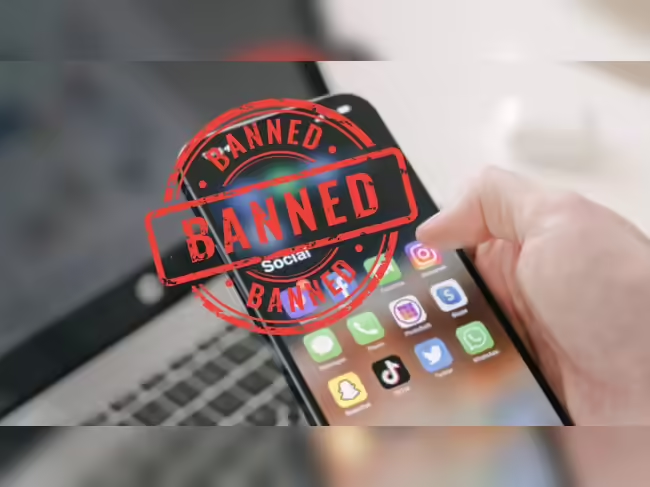
British Prime Minister Keir Starmer has announced plans to ban social media access for children under 16 and impose restrictions on gaming and livestreaming platforms, signalling one of the toughest moves yet by a major economy to curb young people's exposure to online harms.
Taking to X on Monday, Starmer said, “These days kids must find their feet in a world where technology intrudes into every area of their life. I just can’t let that go on anymore. So we’re giving children their childhoods back.”
Acknowledging that it won’t be easy, he added: “It’s fair to say that this decision has been resisted and it will face resistance from some of the most powerful companies in the world. But we will take them on and we will win.”
Tougher rules on the table
The UK government is also considering additional safeguards for minors online, including overnight curfews, mandatory breaks in infinite scrolling, and limits on app usage for those under 18. Further details are expected in July.
The move marks the latest step in Britain's increasingly stringent approach towards technology companies. In recent years, regulators have pushed platforms to introduce age-verification measures, adjust recommendation algorithms, and prevent children from sharing nude images.
Growing concerns over the mental health impact of excessive social media use have also influenced the government's thinking.
Starmer's decision followed a review of evidence from Australia, which introduced a similar ban for under-16s last year.
The country also sought feedback from teachers, parents, young people, and industry stakeholders on possible restrictions, including age limits, app time controls, and measures targeting what officials describe as addictive design features.
The consultation attracted more than 116,000 responses. Among parents who participated, over 83% said the risks of social media outweighed its benefits, while 90% supported setting 16 as the minimum age for access to social media platforms.
Not everyone is convinced though. Some psychologists and researchers have argued there is limited evidence that blanket bans are effective, while schoolchildren interviewed by Reuters said they had a complicated relationship with social media and technology.
Starmer, who is expected to face a leadership challenge in the coming weeks, said the public expected decisive action.
Australia sparks global movement
Australia became the first country to ban social media for children under 16, blocking access in December to platforms including TikTok, YouTube, Instagram, and Facebook.
Since then, countries such as Indonesia, Malaysia, France, and Turkey have started discussions and explored similar measures amid rising concerns about children's safety and wellbeing online.
This comes just as Canada introduced a digital safety bill last week, proposing a ban on social media access for children under 16, while allowing exemptions for platforms that meet specified safety standards.
India in the mix
India is also exploring restrictions on children's access to social media.
In March, ET reported that the Centre had begun firming up its position on whether to ban or restrict social media usage among minors.
The Ministry of Electronics and Information Technology (MeitY) held consultations with social media companies and other stakeholders to assess the technical feasibility of limiting access for users belonging to specific age groups. India currently has no age-based controls on social media access.
That month, Karnataka and Andhra Pradesh also announced plans for similar curbs.
Public support for such measures appears strong. A global survey released in April by the UK-based education charity Varkey Foundation found that 75% of parents in India supported a social media ban for under-16s, the second-highest level among countries surveyed, after Malaysia's 77%.
The study also found that 73% of Gen Z respondents in India backed such a ban — the highest among all countries polled — despite being the first generation to grow up with social media from childhood.
Taking to X on Monday, Starmer said, “These days kids must find their feet in a world where technology intrudes into every area of their life. I just can’t let that go on anymore. So we’re giving children their childhoods back.”
Acknowledging that it won’t be easy, he added: “It’s fair to say that this decision has been resisted and it will face resistance from some of the most powerful companies in the world. But we will take them on and we will win.”
Tougher rules on the table
The UK government is also considering additional safeguards for minors online, including overnight curfews, mandatory breaks in infinite scrolling, and limits on app usage for those under 18. Further details are expected in July.
The move marks the latest step in Britain's increasingly stringent approach towards technology companies. In recent years, regulators have pushed platforms to introduce age-verification measures, adjust recommendation algorithms, and prevent children from sharing nude images.
Growing concerns over the mental health impact of excessive social media use have also influenced the government's thinking.
Starmer's decision followed a review of evidence from Australia, which introduced a similar ban for under-16s last year.
The country also sought feedback from teachers, parents, young people, and industry stakeholders on possible restrictions, including age limits, app time controls, and measures targeting what officials describe as addictive design features.
The consultation attracted more than 116,000 responses. Among parents who participated, over 83% said the risks of social media outweighed its benefits, while 90% supported setting 16 as the minimum age for access to social media platforms.
Not everyone is convinced though. Some psychologists and researchers have argued there is limited evidence that blanket bans are effective, while schoolchildren interviewed by Reuters said they had a complicated relationship with social media and technology.
Starmer, who is expected to face a leadership challenge in the coming weeks, said the public expected decisive action.
Australia sparks global movement
Australia became the first country to ban social media for children under 16, blocking access in December to platforms including TikTok, YouTube, Instagram, and Facebook.
Since then, countries such as Indonesia, Malaysia, France, and Turkey have started discussions and explored similar measures amid rising concerns about children's safety and wellbeing online.
This comes just as Canada introduced a digital safety bill last week, proposing a ban on social media access for children under 16, while allowing exemptions for platforms that meet specified safety standards.
India in the mix
India is also exploring restrictions on children's access to social media.
In March, ET reported that the Centre had begun firming up its position on whether to ban or restrict social media usage among minors.
The Ministry of Electronics and Information Technology (MeitY) held consultations with social media companies and other stakeholders to assess the technical feasibility of limiting access for users belonging to specific age groups. India currently has no age-based controls on social media access.
That month, Karnataka and Andhra Pradesh also announced plans for similar curbs.
Public support for such measures appears strong. A global survey released in April by the UK-based education charity Varkey Foundation found that 75% of parents in India supported a social media ban for under-16s, the second-highest level among countries surveyed, after Malaysia's 77%.
The study also found that 73% of Gen Z respondents in India backed such a ban — the highest among all countries polled — despite being the first generation to grow up with social media from childhood.
Add  as a Reliable and Trusted News Source
as a Reliable and Trusted News Source Add Now!
(Catch all the Technology News News, and Latest News Updates on The Economic Times.)
...more
Elevate your knowledge and leadership skills at a cost cheaper than your daily tea.

Auditor red flagged Gymkhana land issue long before govt action 
Market darling to drawdown: Why momentum stocks are losing steam 
Paisabazaar wanted to get you loans; now it wants your funds 
Melting mountains: Can India defuse 189 looming flood risks in Himalayas? 
To cut or not to cut: What happens to Air India free-meals as losses swell 
Will peace get a chance, and bulls make a comeback? 5 large-cap stocks with an upside potential of up to 26% 
Time to adopt a tactical perspective? 6 metal stocks, 4 with an upside potential of up to 14% 
The accounting trick used by companies to make a weak balance sheet look strong
Subscribe Now
Now Playing
Source link