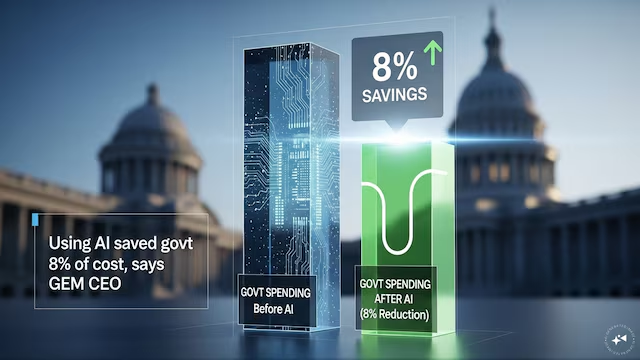
Using AI saved govt 8% of cost, says GEM CEO
GeM CEO Mihir Kumar says AI tools on GeM improve procurement transparency, save about 8%, enforce Make in India preferences, track DVA, and monitor 10 day payment timelines.

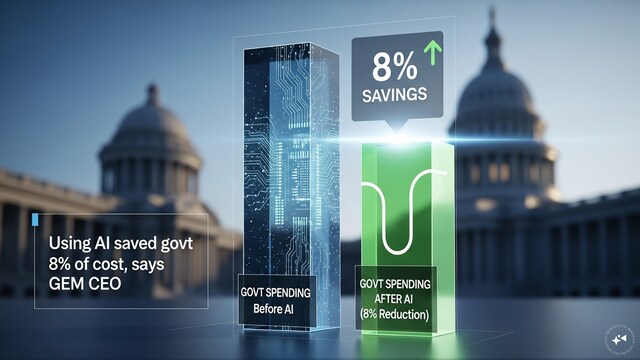
The government's e-marketplace platform, GeM, has helped deliver savings of around 8% to the exchequer by improving efficiency and transparency in public procurement, according to GeM Chief Executive Officer Dr. Mihir Kumar.
Speaking about the platform's use of artificial intelligence, Kumar said AI-powered Price Gap Analysis (PGA) tools help identify instances where listed prices are significantly higher than estimated bid prices. In such cases, GeM engages with sellers and asks them to review their pricing if the AI system flags that the uploaded price is not in line with prevailing market rates or prices available on other electronic marketplaces.
On the buyer side, Kumar said AI tools assist government departments in drafting Requests for Proposals (RFPs) by evaluating key parameters and indicating whether a proposed tender falls into the category of a poor, reasonable, or excellent bid. He noted that AI and machine learning-based use cases play an important role in maintaining GeM as a trust-based procurement platform.
Kumar added that all public procurement policies, including the government's Make in India initiative, are promoted through GeM. The platform distinguishes between Class-I and Class-II suppliers based on self-certification provided by sellers.
Responding to a query on opening public procurement to countries with which India has free trade agreements, Kumar said GeM captures information on domestic value addition (DVA) for products listed on the platform. He added that existing policies also incorporate mechanisms governing business transactions with land border countries (LBCs).
Under the revised Public Procurement (Preference to Make in India) Order, 2017, Class-I local suppliers receive the highest preference in government procurement. While access to procurement by state and local government entities will continue to exclude foreign companies, suppliers eligible to bid for domestic tenders are deemed Class-II local suppliers. Class-I suppliers are defined as those with domestic value addition exceeding 50%, while Class-II suppliers have DVA between 20% and 50%.
Also Read: TCS could have as many AI agents as staff in 3 years; AI not a threat: Chandrasekaran
On payment timelines, Kumar said GeM has an escalation matrix in place, including notifications to buyers regarding whether payments have been made within the stipulated period of 10 days. While acknowledging that certain issues may delay payments, he said the platform ultimately leaves it to the buyer's discretion to determine the reasons for non-payment within the prescribed timeline.
Commenting on the possibility of bringing works contracts onto the GeM platform, Kumar said discussions are ongoing, but no decision has been finalised so far.
Also Read: India's data centre capacity could reach 15 GW in five years on AI demand: L&T Vyoma
Speaking about the platform's use of artificial intelligence, Kumar said AI-powered Price Gap Analysis (PGA) tools help identify instances where listed prices are significantly higher than estimated bid prices. In such cases, GeM engages with sellers and asks them to review their pricing if the AI system flags that the uploaded price is not in line with prevailing market rates or prices available on other electronic marketplaces.
He said the mechanism helps maintain "price sanity" by ensuring that listed prices remain reflective of representative market prices.
On the buyer side, Kumar said AI tools assist government departments in drafting Requests for Proposals (RFPs) by evaluating key parameters and indicating whether a proposed tender falls into the category of a poor, reasonable, or excellent bid. He noted that AI and machine learning-based use cases play an important role in maintaining GeM as a trust-based procurement platform.
Kumar added that all public procurement policies, including the government's Make in India initiative, are promoted through GeM. The platform distinguishes between Class-I and Class-II suppliers based on self-certification provided by sellers.
Responding to a query on opening public procurement to countries with which India has free trade agreements, Kumar said GeM captures information on domestic value addition (DVA) for products listed on the platform. He added that existing policies also incorporate mechanisms governing business transactions with land border countries (LBCs).
Under the revised Public Procurement (Preference to Make in India) Order, 2017, Class-I local suppliers receive the highest preference in government procurement. While access to procurement by state and local government entities will continue to exclude foreign companies, suppliers eligible to bid for domestic tenders are deemed Class-II local suppliers. Class-I suppliers are defined as those with domestic value addition exceeding 50%, while Class-II suppliers have DVA between 20% and 50%.
Also Read: TCS could have as many AI agents as staff in 3 years; AI not a threat: Chandrasekaran
On payment timelines, Kumar said GeM has an escalation matrix in place, including notifications to buyers regarding whether payments have been made within the stipulated period of 10 days. While acknowledging that certain issues may delay payments, he said the platform ultimately leaves it to the buyer's discretion to determine the reasons for non-payment within the prescribed timeline.
Commenting on the possibility of bringing works contracts onto the GeM platform, Kumar said discussions are ongoing, but no decision has been finalised so far.
Also Read: India's data centre capacity could reach 15 GW in five years on AI demand: L&T Vyoma
Source link