Why Jeff Bezos thinks the next AI revolution will happen in factories, not offices
Prometheus founders Jeff Bezos and Vik Bajaj believe the biggest opportunity for artificial intelligence lies beyond chatbots and coding assistants. Their startup is developing AI tools designed to help engineers design, test and manufacture complex products faster, potentially reshaping industries ranging from aerospace and semiconductors to energy and industrial manufacturing.
5 Min Read


For most people, artificial intelligence today means chatbots, coding assistants and tools that help office workers become more productive. Jeff Bezos believes that is only the beginning.
Bezos says the next major AI revolution is likely to happen not in offices, but in factories, engineering labs and manufacturing plants, where AI could help create everything from jet engines and semiconductors to batteries and solar equipment faster than ever before.
So why does Bezos think the next wave of AI will emerge from factories rather than offices?
The answer begins with the limitations of today's AI systems.
According to Bezos, large language models such as ChatGPT have proven exceptionally good at knowledge work. They can write, code, analyse information and solve mathematical problems. However, building a bridge, designing a jet engine or creating a next-generation semiconductor manufacturing tool requires a very different type of intelligence.
"As impressive and useful as they are, LLMs have been trained on a giant corpus of humanity's knowledge that already existed on the internet," Bezos told CNBC in an exclusive interview. "What we're doing is very different."
Vik Bajaj argues that physical-world engineering cannot be reduced to words alone.
"You don't build a bridge or a jet engine through words," he said. "To understand how something works inside an object, you have to understand the physics."
That means understanding how materials behave, how forces interact, how manufacturing processes work and how thousands of individual components come together to form a functioning product.
For decades, engineers have relied on computer-aided design tools, simulations and physical prototypes to solve those challenges. But developing advanced products remains a slow and expensive process.
A modern jet engine, for example, can take thousands of engineers and more than a decade to design, test and manufacture. Similar timelines exist across many industries, including semiconductors, energy infrastructure and advanced manufacturing.
Prometheus believes AI can dramatically reduce those development cycles.
"What has changed in the last few years is the ability to formulate even something as complicated as that — from design to manufacturing — as an end-to-end AI problem," Bajaj said.
The company's long-term vision is what Bezos describes as an "artificial general engineer" — a set of AI tools capable of helping engineers move from concept to production far more quickly than is possible today.
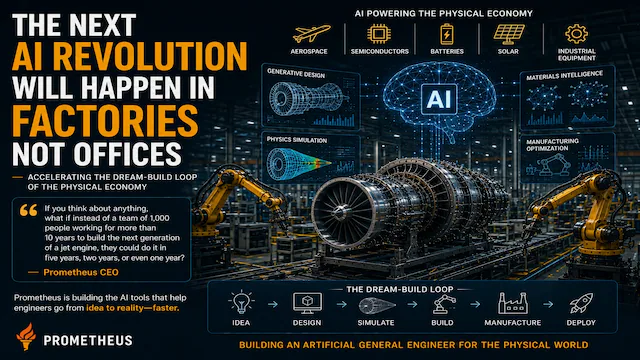
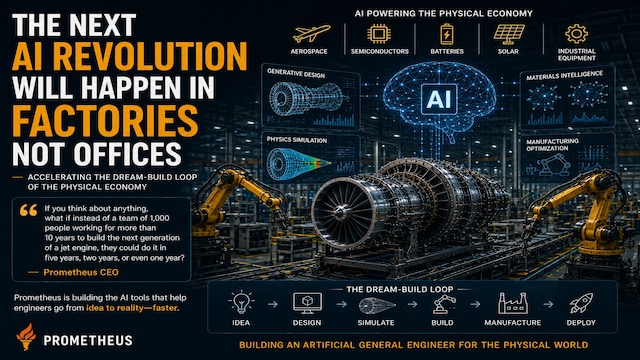
Bezos said the objective is to accelerate what he calls the "dream-build loop" — the process through which an idea becomes a real-world product.
"If you think about anything, what if instead of a team of 1,000 people working for more than 10 years to build the next generation of a jet engine, they could do it in five years, two years, or even one year?" he said.
The implications, if successful, could extend far beyond any single industry.
Prometheus sees opportunities across sectors ranging from semiconductors and aerospace to batteries, solar manufacturing and industrial equipment. The founders argue that shortening engineering cycles would allow companies to innovate more quickly, bringing new products and technologies to market at a faster pace.
Bajaj noted that even a smartphone relies on thousands of manufacturing processes, some dating back centuries and others invented only recently. Bringing those processes together efficiently remains one of the biggest challenges in modern industry.
The founders also reject the idea that such advances would necessarily lead to widespread job losses.
Bezos said he expects productivity gains from AI to improve living standards rather than eliminate work. Bajaj argued that faster innovation would create new industries and increase demand for engineers and manufacturing workers.
"We will create more engineers. We will have more jobs in engineering and manufacturing as a result of inventing more," Bajaj said.
Also Read | AI's next winners may lie beyond GenAI, says Natixis economist
For now, however, both founders acknowledge that the technology remains at an early stage.
Prometheus employs around 150 people across London and Zurich and continues to invest heavily in research, data and computing infrastructure. Bezos said building the datasets and computational systems required for this kind of engineering AI is both technically difficult and capital-intensive.
The company believes the opportunity is worth pursuing because the physical economy remains one of the largest sectors yet to be transformed by AI. Bajaj estimates it represents roughly 60% of global GDP.
"We need to be very humble about this," Bezos said. "It's very early. We're working very hard. This is not a done deal."
Still, if Bezos and Bajaj are right, the next chapter of the AI story may not be written by office workers using chatbots, but by engineers using AI to design and build the physical world faster than ever before.
Also Read | Jeff Bezos likens AI boom to the 1990s biotech bubble, says society will benefit anyway
Bezos says the next major AI revolution is likely to happen not in offices, but in factories, engineering labs and manufacturing plants, where AI could help create everything from jet engines and semiconductors to batteries and solar equipment faster than ever before.
That belief sits at the heart of Prometheus, the startup Bezos co-founded with Vik Bajaj. The company, which has remained largely under the radar until now, is raising a Series B round of $12 billion, valuing it at roughly $41 billion. Its ambition is to use AI to accelerate engineering across what it calls the "physical economy" — the industries that design, build and manufacture the products that underpin modern life.
So why does Bezos think the next wave of AI will emerge from factories rather than offices?
The answer begins with the limitations of today's AI systems.
According to Bezos, large language models such as ChatGPT have proven exceptionally good at knowledge work. They can write, code, analyse information and solve mathematical problems. However, building a bridge, designing a jet engine or creating a next-generation semiconductor manufacturing tool requires a very different type of intelligence.
"As impressive and useful as they are, LLMs have been trained on a giant corpus of humanity's knowledge that already existed on the internet," Bezos told CNBC in an exclusive interview. "What we're doing is very different."
Vik Bajaj argues that physical-world engineering cannot be reduced to words alone.
"You don't build a bridge or a jet engine through words," he said. "To understand how something works inside an object, you have to understand the physics."
That means understanding how materials behave, how forces interact, how manufacturing processes work and how thousands of individual components come together to form a functioning product.
For decades, engineers have relied on computer-aided design tools, simulations and physical prototypes to solve those challenges. But developing advanced products remains a slow and expensive process.
A modern jet engine, for example, can take thousands of engineers and more than a decade to design, test and manufacture. Similar timelines exist across many industries, including semiconductors, energy infrastructure and advanced manufacturing.
Prometheus believes AI can dramatically reduce those development cycles.
"What has changed in the last few years is the ability to formulate even something as complicated as that — from design to manufacturing — as an end-to-end AI problem," Bajaj said.
The company's long-term vision is what Bezos describes as an "artificial general engineer" — a set of AI tools capable of helping engineers move from concept to production far more quickly than is possible today.
Bezos said the objective is to accelerate what he calls the "dream-build loop" — the process through which an idea becomes a real-world product.
"If you think about anything, what if instead of a team of 1,000 people working for more than 10 years to build the next generation of a jet engine, they could do it in five years, two years, or even one year?" he said.
The implications, if successful, could extend far beyond any single industry.
Prometheus sees opportunities across sectors ranging from semiconductors and aerospace to batteries, solar manufacturing and industrial equipment. The founders argue that shortening engineering cycles would allow companies to innovate more quickly, bringing new products and technologies to market at a faster pace.
Bajaj noted that even a smartphone relies on thousands of manufacturing processes, some dating back centuries and others invented only recently. Bringing those processes together efficiently remains one of the biggest challenges in modern industry.
The founders also reject the idea that such advances would necessarily lead to widespread job losses.
Bezos said he expects productivity gains from AI to improve living standards rather than eliminate work. Bajaj argued that faster innovation would create new industries and increase demand for engineers and manufacturing workers.
"We will create more engineers. We will have more jobs in engineering and manufacturing as a result of inventing more," Bajaj said.
Also Read | AI's next winners may lie beyond GenAI, says Natixis economist
For now, however, both founders acknowledge that the technology remains at an early stage.
Prometheus employs around 150 people across London and Zurich and continues to invest heavily in research, data and computing infrastructure. Bezos said building the datasets and computational systems required for this kind of engineering AI is both technically difficult and capital-intensive.
The company believes the opportunity is worth pursuing because the physical economy remains one of the largest sectors yet to be transformed by AI. Bajaj estimates it represents roughly 60% of global GDP.
"We need to be very humble about this," Bezos said. "It's very early. We're working very hard. This is not a done deal."
Still, if Bezos and Bajaj are right, the next chapter of the AI story may not be written by office workers using chatbots, but by engineers using AI to design and build the physical world faster than ever before.
Also Read | Jeff Bezos likens AI boom to the 1990s biotech bubble, says society will benefit anyway
(Edited by : Prashant)
Source link