An Entrackr investigation has found that at least five restaurant listings operating simultaneously on Swiggy in Gurugram appear to be the same physical kitchen masquerading under different names, raising serious questions around the platform’s verification systems, review integrity, advertising fairness, and even investor-facing marketplace metrics.
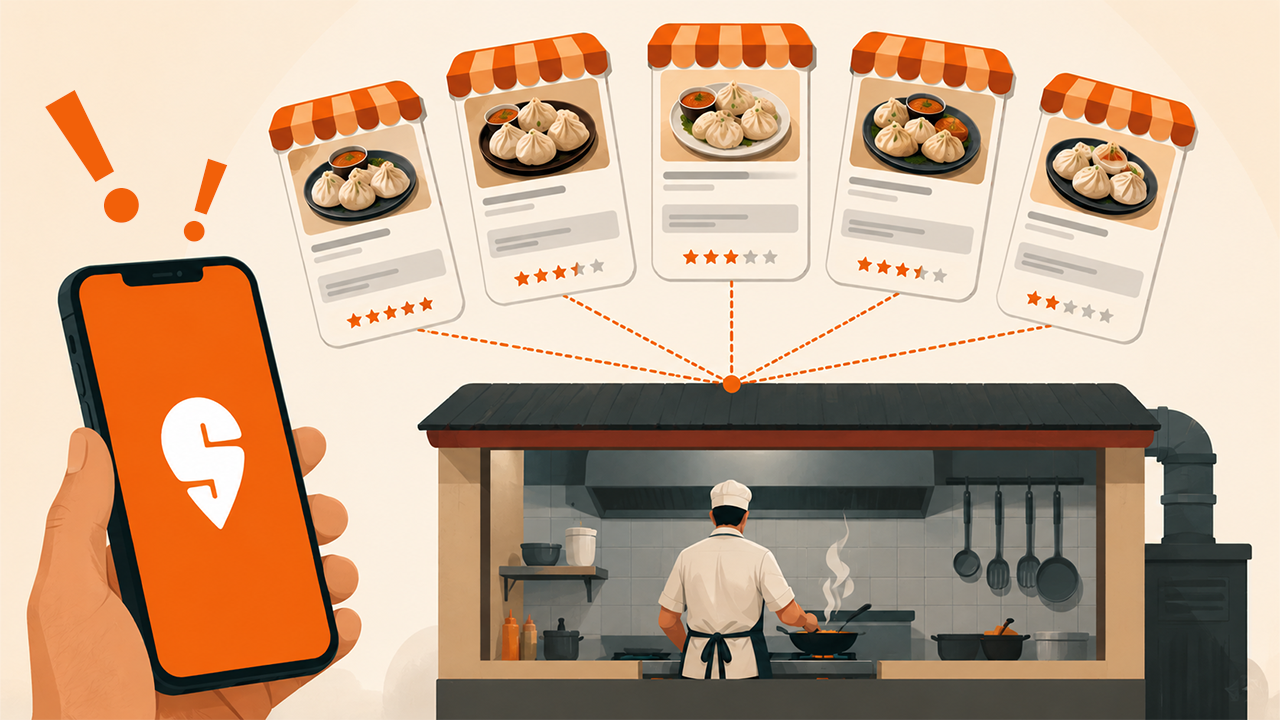
The five listings: Momo Palace China, Crispy Crunch Momos, The Momos House, Momo Factory, and Humpty Momos all share the exact same FSSAI license number (20821005002678), the same physical address in Sector 11, Gurugram, and nearly identical menus, pricing, and food photographs.
Entrackr recorded all five storefronts appearing live on Swiggy simultaneously.
Five different restaurant identities. One kitchen.
And the implications go far beyond duplicate listings.
Because Swiggy’s onboarding process is supposed to verify restaurant credentials before approving listings. The FSSAI number is a unique identifier. By the time the second, third, fourth, and fifth storefronts using the exact same credentials appeared, Swiggy’s systems already had the data required to flag them.
But they were approved anyway.
That raises uncomfortable possibilities. Either Swiggy’s verification systems lack basic de-duplication checks for one of the most important food compliance identifiers, or those checks exist and were bypassed.
Both scenarios raise difficult questions for a listed company handling millions of consumers and merchants.
Entrackr sent detailed queries to Swiggy earlier this month on how these listings cleared verification, whether duplicate storefronts distort ratings and advertising fairness, and how the company defines restaurant partner metrics in investor disclosures. Swiggy declined to participate in the story.
Sources familiar with Swiggy’s merchant onboarding process told Entrackr that multiple listings repeatedly clearing verification with identical FSSAI credentials and addresses would likely require more than a simple technology oversight.
“Five times is not accidental,” one source said. “At some stage, someone would have noticed the credentials already existed.”
That possibility opens another line of concern: whether duplicate storefronts create commercial advantages that benefit both operators and potentially internal teams, facilitating onboarding approvals.
The impact on consumers is immediate.
Swiggy’s trust system depends on users believing that every listing represents a separate restaurant. But if one kitchen can repeatedly appear under fresh identities, the platform’s rating and review mechanism begins to break down.
Consider a consumer in Sector 11 who ordered from Momo Palace China last month, received cold food, and left a one-star review warning others. This week, avoiding that listing, the consumer clicked on Crispy Crunch Momos, a different name, no bad reviews, seemingly a fresh choice. The food arrived from the same shop. Cooked in the same kitchen. By the same people.
Their one-star review, their only meaningful consumer protection tool on the platform, had effectively been erased by a new listing name.
On Swiggy, it appears, a bad restaurant never has to die. It just needs a new name.
And the algorithmic incentives are even more troubling.
Every fresh listing starts with a reset reputation. Negative reviews disappear. Recommendation systems treat the restaurant as new. Search rankings restart. In effect, duplicate storefronts can function as reputation laundering mechanisms inside the platform economy.
The problem extends into advertising as well.
Swiggy monetises visibility through promoted listings. One operator controlling five storefronts from the same kitchen can potentially occupy multiple sponsored positions simultaneously, crowding out legitimate competitors operating with a single identity.
“This creates a structural advantage,” another source familiar with platform advertising systems said. “One honest restaurant buys one slot. Another operator buys five.”
The findings also raise questions around Swiggy’s investor disclosures.
Swiggy regularly reports restaurant partner numbers as a key marketplace metric. But Entrackr asked the company whether those figures represent unique physical food businesses or total active storefront listings. Swiggy declined to comment and chose not to participate in the story.
That distinction matters.
Because if one kitchen can appear five times, then the marketplace scale itself may look materially different depending on how “restaurant partners” are counted.
Interestingly, FSSAI regulations themselves may allow a single license to cover multiple establishments using the same name within a local area. But why are consumers on Swiggy being shown what appears to be multiple independent restaurant identities tied to the same kitchen without disclosure?
And ultimately, that leaves one fundamental question:
When users browse food delivery apps, are they actually choosing between different restaurants, or simply different names attached to the same kitchen?
Source link