BYD unveils China's first 4nm smart-driving chip, brings LiDAR to its $10,300 EV
BYD has unveiled its 4nm Xuanji A3 smart-driving chip, claiming 2,100 TOPS from a three-chip cluster and support for Level 3 and Level 4 autonomy, intensifying China’s EV tech race.
3 Min Read


BYD Co. unveiled its first in-house smart-driving chip Thursday, staking a claim in a growing technology race among Chinese electric vehicle makers. The chip, named Xuanji A3, is China's first based on 4-nanometer architecture and supports Level 3 and Level 4 autonomous driving.
According to the company, three chips clustered together deliver over 2,100 TOPS of combined computing power. BYD says integration with its in-house algorithms has doubled computing power utilisation.
Chip and Platform Details
The Xuanji A3 has entered mass production and anchors BYD's new central computing platform, which unifies three previously separate vehicle systems: the smart cockpit, driver-assistance, and electric propulsion software. BYD says the chip consumes 20% less power than comparable semiconductors.
CEO Wang Chuanfu said at the Shenzhen event that BYD is the only automaker globally with full in-house chip manufacturing, covering seven steps from architecture design to wafer production and testing.
The company has invested over 100 billion yuan ($14.75 billion) in semiconductors, employs over 7,000 chip engineers across four R&D bases, operates five wafer fabs, and has launched over 2,000 chip products since setting up a dedicated chip division in 2002.
Also Read: Huawei plans to build 1.4nm chips without the machine that powers TSMC, Samsung, and IntelSmart Driving Expansion
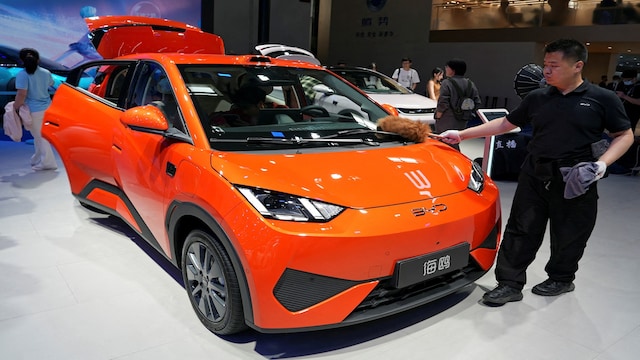
BYD will expand its God's Eye driver-assistance system across all China models, including the mass-market Seagull hatchback starting at 69,800 yuan ($10,300).
LiDAR sensors, typically reserved for premium vehicles, will be offered as a paid add-on at 12,000 yuan — giving BYD a new revenue stream amid a price war that has pressured margins.
"Even the affordable Seagull or Dolphin models can be equipped with the smart driving experience that usually goes with luxury cars," Wang said. "Our add-on package is the most sincere in the industry, priced only at cost."
Wang also announced one year of insurance covering damages from accidents when God's Eye is active. The system has drawn complaints for underdelivering on its stated capabilities. Some analysts note BYD's automation performance has historically trailed Tesla.
The Broader Race
The launch sharpens competition with Huawei and EV rivals developing their own chips. Nio's 5nm Shenji NX9031 is deployed across its lineup. Xpeng is transitioning to its in-house Turing AI chip. Li Auto unveiled its 5nm Mach M100 earlier this month.
Tesla, meanwhile, is pursuing a camera-only approach and working to clear regulatory approval for its Full Self-Driving system in China under a different name. BYD is awaiting Chinese legislation permitting wider consumer deployment of autonomous vehicles, expected by 2027.
BYD says over 3.15 million of its vehicles with driver-assistance hardware are on the road, generating roughly 200 million kilometres of driving data daily. The announcement comes after eight consecutive months of declining sales.
According to the company, three chips clustered together deliver over 2,100 TOPS of combined computing power. BYD says integration with its in-house algorithms has doubled computing power utilisation.
BYD shares rose as much as 3% in Hong Kong trading on Friday before easing slightly.
Chip and Platform Details
The Xuanji A3 has entered mass production and anchors BYD's new central computing platform, which unifies three previously separate vehicle systems: the smart cockpit, driver-assistance, and electric propulsion software. BYD says the chip consumes 20% less power than comparable semiconductors.
CEO Wang Chuanfu said at the Shenzhen event that BYD is the only automaker globally with full in-house chip manufacturing, covering seven steps from architecture design to wafer production and testing.
The company has invested over 100 billion yuan ($14.75 billion) in semiconductors, employs over 7,000 chip engineers across four R&D bases, operates five wafer fabs, and has launched over 2,000 chip products since setting up a dedicated chip division in 2002.
Also Read: Huawei plans to build 1.4nm chips without the machine that powers TSMC, Samsung, and IntelSmart Driving Expansion
BYD will expand its God's Eye driver-assistance system across all China models, including the mass-market Seagull hatchback starting at 69,800 yuan ($10,300).
LiDAR sensors, typically reserved for premium vehicles, will be offered as a paid add-on at 12,000 yuan — giving BYD a new revenue stream amid a price war that has pressured margins.
"Even the affordable Seagull or Dolphin models can be equipped with the smart driving experience that usually goes with luxury cars," Wang said. "Our add-on package is the most sincere in the industry, priced only at cost."
Wang also announced one year of insurance covering damages from accidents when God's Eye is active. The system has drawn complaints for underdelivering on its stated capabilities. Some analysts note BYD's automation performance has historically trailed Tesla.
The Broader Race
The launch sharpens competition with Huawei and EV rivals developing their own chips. Nio's 5nm Shenji NX9031 is deployed across its lineup. Xpeng is transitioning to its in-house Turing AI chip. Li Auto unveiled its 5nm Mach M100 earlier this month.
Tesla, meanwhile, is pursuing a camera-only approach and working to clear regulatory approval for its Full Self-Driving system in China under a different name. BYD is awaiting Chinese legislation permitting wider consumer deployment of autonomous vehicles, expected by 2027.
BYD says over 3.15 million of its vehicles with driver-assistance hardware are on the road, generating roughly 200 million kilometres of driving data daily. The announcement comes after eight consecutive months of declining sales.
Source link