US export controls on advanced AI models have spurred India's call for sovereign AI development. Industry leaders warn against reliance on foreign providers, urging a national mission for indigenous AI capabilities, similar to UPI and Aadhaar, to secure India's technological future and support local startups.
Listen to this article in summarized format
The US government’s export-control directive that forced Anthropic to shut out foreigners from accessing Fable 5 has triggered calls from Indian venture capital investors and AI ecosystem leaders to accelerate the country's sovereign AI ambitions. With the viability of Indian AI startups under threat, industry stakeholders warned that dependence on a handful of overseas foundation model providers exposes enterprises and governments to a high degree of geopolitical risk.
They argued that India needs to build its own AI capabilities, much like it did with digital public infra like UPI and Aadhaar.
Call for prioritising
“If this is not a wake-up call for the country, I don't know what is,” said Aakrit Vaish, cofounder of AI-focused early stage venture capital firm Activate. “India needs mission-driven teams focused on long-term AI research and development, backed by sustained capital and policy support.”
In a statement on June 12, Anthropic said the US government had issued an “expert control directive to suspend all access to Fable 5 and Mythos 5 by any foreign national inside or outside the US including foreign national Anthropic employees. The net effect of this order is that we must abruptly disable Fable 5 and Mythos 5 for all our customers to ensure compliance. Access to all other Anthropic models will not be affected.”
ETtech
Fable 5 and Mythos 5 are Anthropic's latest large language models built for advanced reasoning and agentic tasks.
For investors and founders, the stoppage reinforces a broader message: AI is increasingly becoming strategic infrastructure, and relying on a single provider is no longer a sustainable long-term strategy. Several described AI as a new supply chain risk.
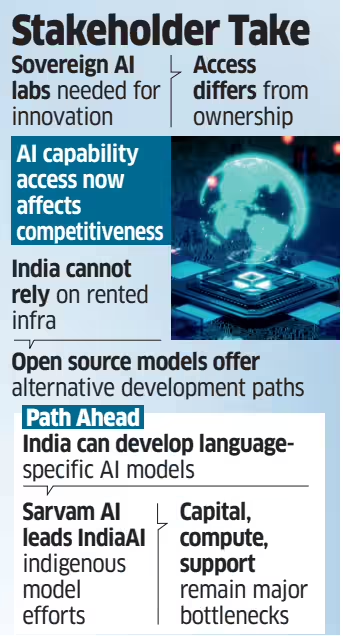
Policymakers should prioritise creating sovereign AI labs that can drive innovation while nurturing startups and AI talent, said Vaish, who earlier served as adviser to the government on the IndiaAI Mission.
“We can experiment with new architectures. We can build smaller models, build models designed specifically for Indian languages and use cases,” he said, adding that India has many opportunities that do not require the same level of capital or the exact same approach that frontier labs elsewhere have taken.
Status check
Currently, India’s sovereign AI push hinges on Sarvam AI, the Bengaluru-based startup that was selected under the IndiaAI Mission to build indigenous foundation models.
“For AI users, it is clear that you should not confuse access with ownership, or adoption itself as an advantage,” Pratyush Kumar, cofounder of Sarvam AI, said on X.
Sarvam AI has raised $41 million to date, while US-based frontier labs Anthropic and OpenAI have together raised approximately $350 billion so far.
Earlier, ET reported on how Sarvam is in talks to raise $250-300 million at a valuation of about $1.2-1.5 billion from Noida-headquartered software services company HCLtech, chipmaker Nvidia, Bessemer Venture Partners, Glade Brook Capital and others.
Over the past two years, over 100 Indian founders have moved to the US to build AI companies. The curbs could be a matter of survival for Indian startups.
Shashank Agarwal, cofounder of Noveum.ai and currently based in San Francisco, was one of those who got the door slammed in their faces by the US. “My team and I were using it (Anthropic advanced models) 24/7 and the moment it was shut down, we were all discussing it internally,” he told ET.
Emphasising that Indian companies are building for the world, Vijay Rayapati, chief executive, Atomicwork, said, “Now, just because you are not a citizen, your engineers don't have access to capability. How do you compete?”
Another US-based founder said that cutting off access to the latest models is like the US blocking access to Covid-19 vaccines to non-Americans during the pandemic. “This means basically you suffer or die,” he said.
Rayapati said such policies have been used previously in the defence and chip industries. “The architecture for a fighter jet, submarine and nuclear fusion changes once a decade, and chips such as graphic processing units, it is a five-seven year time frame. But in the case of AI, architecture changes multiple times a year. There is no way to keep up with this acceleration if you don't have access,” said Rayapati, also based in San Francisco.
Agarwal of Noveum said Indian startups will lose out on compounding. “With the latest models, you are writing code, building business. If you keep doing it for a few months, they compound, and that will be impacted,” he said.
Currently, Anthropic does not collect data about users’ citizenship. Under the US directive, multiple Indian founders who are green card holders and on skilled-based visas in the US will not have access to the model. Implementation will be a challenge though, especially if a founder is not a US citizen and a section of the employees are, said executives. This includes companies such as Anthropic that employ foreign nationals.
“It is a matter of survival. At this point it does not matter if you are in San Francisco or Sakleshpur, you are not getting access anyway,” said the founder cited above.
Stakeholders said India can no longer afford to rent critical technology infrastructure.
Jaspreet Bindra, cofounder of AI literacy organisation AI&Beyond, said the significance of the move lies in the precedent it establishes. “The problem is not the withdrawal of Fable 5 itself. The problem is that this possibility now exists and has been demonstrated. That is the bigger concern for startups and for countries that rely heavily on foreign AI infrastructure,” he said.
Bindra added that India should also explore open-source alternatives, including Chinese models, while simultaneously developing domestic capabilities.
TV Mohandas Pai, chairman of Aarin Capital, called for an India AI Mission led by Prime Minister Narendra Modi with Nandan Nilekani as vice-chair and participation from both government and the private sector.
“We are way behind and need a national mission to get going quickly. Existing government programmes are too slow, way too small to make any large impact,” Pai wrote on X. He proposed an annual Rs 50,000-crore fund for deeptech and AI, and a Rs 2-lakh crore guarantee fund to build cloud, hardware and semiconductor infrastructure.
Manav Garg, executive chairman of vibe-coding platform Emergent and founder of venture capital firm Together Fund, said startups and enterprises will increasingly have to think about AI infrastructure the same way they think about commodity supply chains. “We talk about grain supplies, metals, rare earths and other strategic resources. Similarly, we now have AI supply-chain risk,” he said.
Companies will need orchestration layers capable of routing workloads across multiple models based on cost, availability and performance, reducing dependence on any one provider.
Ravi Jain, investment director at TDK Ventures, said Indian application-layer companies could find themselves at a disadvantage if access to the latest foundation models becomes restricted.
“The reason is that such companies could increasingly become reliant on older versions of models, which are by definition inferior to the latest frontier models,” he said.
Investors said the restrictions could accelerate adoption of open-source models and create new opportunities for startups building foundational AI technologies.
“This creates space for new startups and research efforts focused on foundation models themselves,” Jain said.
Funding alone will not solve the problem.
“The issue is fundamentally a supply problem, not a money problem,” Garg said, adding that India needs a stronger pipeline of startups building foundational technologies.
Industry leaders also noted that developers have wanted to build indigenous AI capabilities for years, but access to capital, compute infrastructure and long-term institutional support has remained limited.
We strive to uphold the highest ethical standards in all of our reporting and coverage. We StartupNews.fyi want to be transparent with our readers about any potential conflicts of interest that may arise in our work. It's possible that some of the investors we feature may have connections to other businesses, including competitors or companies we write about. However, we want to assure our readers that this will not have any impact on the integrity or impartiality of our reporting. We are committed to delivering accurate, unbiased news and information to our audience, and we will continue to uphold our ethics and principles in all of our work. Thank you for your trust and support.







 ETtech
 as a Reliable and Trusted News Source
 Add Now!