Instant home services platforms like Urban Company, Snabbit, and Pronto are aggressively spending millions on discounts again to capture market share. Despite increased cash burn, order growth is modest, indicating a fierce customer acquisition battle. Companies are prioritising scale over immediate profits in this competitive landscape.
Listen to this article in summarized format
The instant househelp segment is burning through cash at a faster clip once again, with Urban Company, Snabbit and Pronto ramping up discounts in May after temporarily pulling back incentives in April amid a labour shortage.
The combined monthly cash burn across the three players rose 25% month-on-month to $14-15 million in May, according to multiple industry executives. This was around $10-12 million in April.
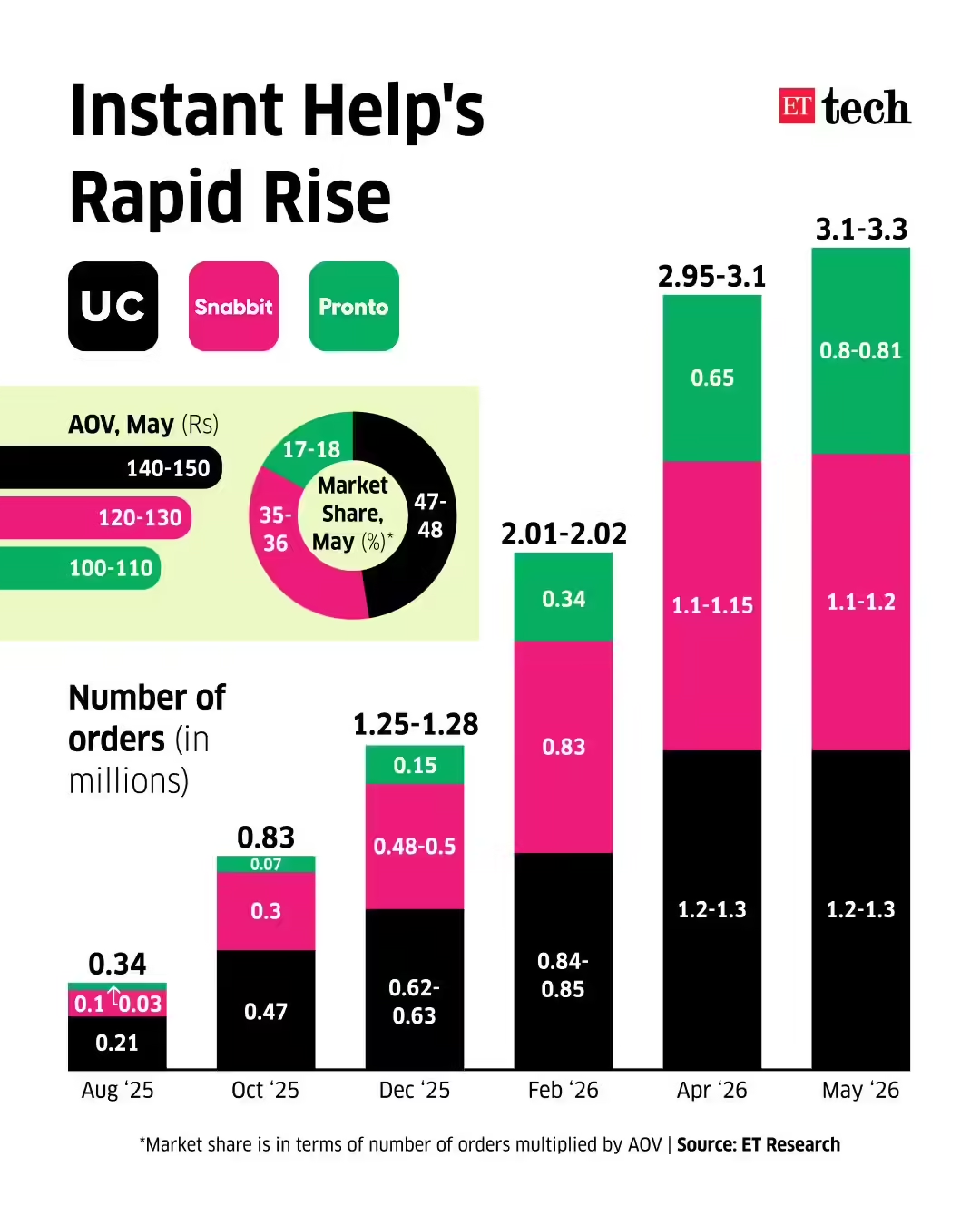
The higher spending, however, does not seem to have helped accelerate demand. Total orders rose to around 3.2-3.3 million in May from 2.9-3.1 million in April, executives said.
Urban Company's InstaHelp service processed roughly 1.2-1.3 million orders during the month, while Snabbit handled 1.1-1.2 million orders. Pronto recorded around 800,000-810,000 orders.
ETtech
“What we're seeing is a classic land grab strategy…the category is still in its customer acquisition phase and companies believe scale today will translate into better economics later. The question is how long investors remain comfortable funding that thesis,” said a venture capital investor who has backed a company in this space.
The renewed discounting follows a temporary reset in April, when labour shortages created supply-side disruptions across the industry, ET had reported last month. With demand outstripping available workers, platforms raised prices in several mature micro-markets. As supply normalised in May, competition intensified, pushing companies back into customer acquisition mode.
Snabbit, for instance, is offering a one-time package of three 60-minute visits for Rs 199 in select micro-markets across Bengaluru and Gurugram. Urban Company is onboarding new users with a Re 1 trial offer for InstaHelp services.
The aggressive promotions weighed on net average order values (AOVs) for some. InstaHelp's net AOV fell to Rs 140-150 in May from Rs 180-200 in April, according to people in the know of these numbers. Snabbit's declined to Rs 120-130 from Rs 160-180 over the same period. Pronto's net AOV remained relatively stable at around Rs 100-110.
After announcing its March-quarter results, Urban Company founder and chief executive Abhiraj Singh Bhal said InstaHelp’s losses would remain elevated as the Gurugram-based company prioritises market share over short-term profitability.
“We are optimising to win and capture market share, which means if we have to match irrationality from time to time, we are fully prepared to do so,” he said during an analyst call. Urban Company’s losses in the March quarter jumped 57-fold to Rs 161 crore, as it ramped up its expenses on InstaHelp.
Urban Company and Snabbit did not respond to ET’s queries.
Pronto said its total burn last month was Rs 23 crore, or roughly Rs 290 per order.
The surge in spending comes as competition intensifies in the emerging 10-minute home services market, where well-funded startups are chasing scale. Pronto extended its funding round in May with a fresh $20 million investment from tech investor Lachy Groom, doubling its valuation to $200 million. Snabbit raised $56 million in April in a round co-led by Susquehanna Venture Capital, Unicorn Growth Fund and Bertelsmann India Investments at a $350 million valuation.
A recent Morgan Stanley report pointed to shifting competitive dynamics in the category. "Within instant services apps, Urban Company's MAU (monthly active user) share declined in May, although its app download share increased relative to privately held peers," the brokerage said.
According to the report, Urban Company had 6.7 million monthly active users in the instant-help segment in May, compared with 3.8 million for Pronto and 1.4 million for Snabbit.
“Every player is trying to establish density in a handful of micro-markets before expanding. That naturally leads to aggressive discounting because the winner is likely to be the platform that becomes the default habit,” a senior industry executive said.
We strive to uphold the highest ethical standards in all of our reporting and coverage. We StartupNews.fyi want to be transparent with our readers about any potential conflicts of interest that may arise in our work. It's possible that some of the investors we feature may have connections to other businesses, including competitors or companies we write about. However, we want to assure our readers that this will not have any impact on the integrity or impartiality of our reporting. We are committed to delivering accurate, unbiased news and information to our audience, and we will continue to uphold our ethics and principles in all of our work. Thank you for your trust and support.







 ETtech
 as a Reliable and Trusted News Source
 Add Now!